
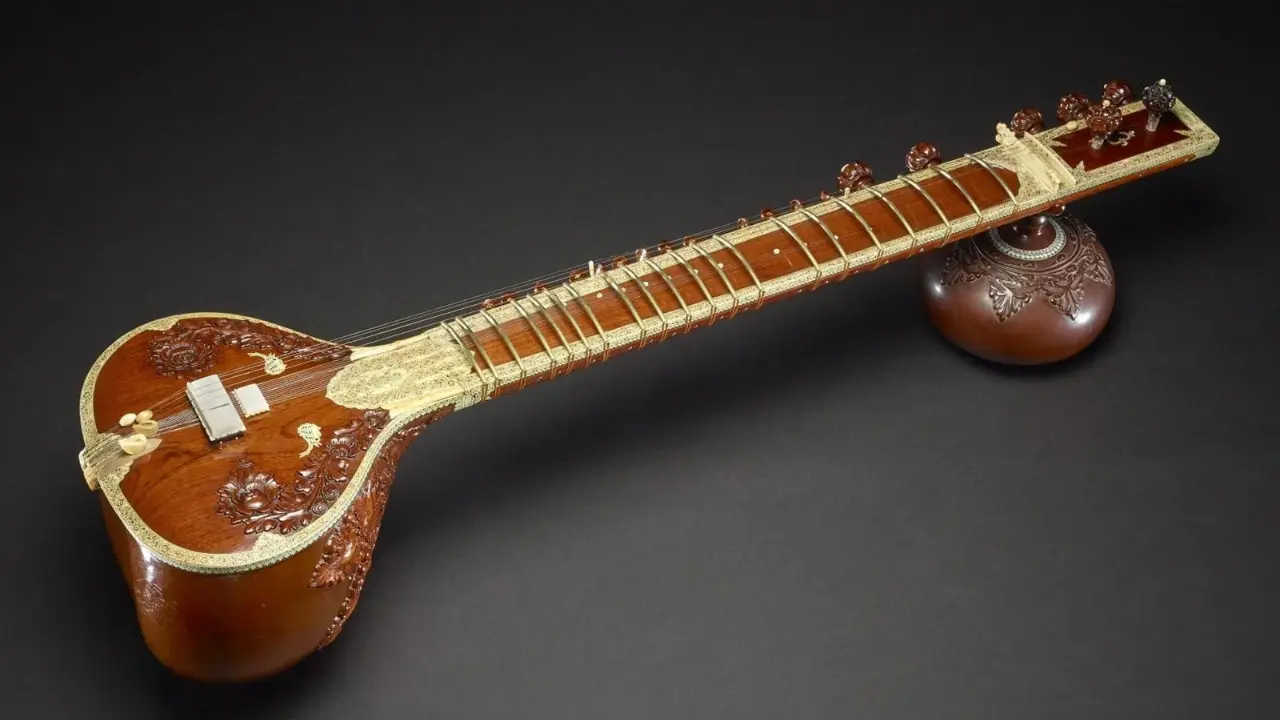
The sitar, with its resonant strings and hypnotic bends, is more than an instrument—it’s a cultural icon. From the courts of Mughal emperors to psychedelic rock concerts, its journey spans centuries and continents. This article explores the sitar’s origins, evolution, and the maestros who made it legendary.
1. Ancient Origins: The Sitar’s Ancestors
The Veena and Persian Setar
The sitar’s design borrows from two ancient instruments:
-
Indian Veena: A fretless string instrument mentioned in Vedic texts (1500 BCE).
-
Persian Setar: A 3-string lute brought to India by Sufi musicians in the 13th century.
The fusion of these designs under Mughal patronage (16th–18th centuries) birthed the early sitar.
2. Medieval India: Amir Khusro’s Legacy
The Innovator: Amir Khusro (1253–1325)
A poet-musician in Emperor Alauddin Khilji’s court, Khusro is often (debatedly) credited with inventing the sitar by modifying the tritantri veena. His contributions laid the groundwork for Hindustani classical music.
Mughal Patronage
Under Akbar’s reign, the sitar gained prominence in royal mehfils (musical gatherings). Craftsmen added frets (pardas) and sympathetic strings (tarabs) for richer resonance.
3. The Modern Sitar: 19th–20th Century Revolution
Key Modifications
-
Strings: From 3 to 18–21 strings (6–7 played, rest as tarabs).
-
Gourd Design: Larger tumba (resonator) for deeper sound.
-
Frets: Curved metal frets for precise meend (glides).
Ravi Shankar: Global Ambassador
Caption: Pandit Ravi Shankar performing at Woodstock (1967).
Shankar’s collaborations with The Beatles (1960s) and his Gandhar Pancham tuning made the sitar a worldwide sensation.
4. Cultural Impact: Classical to Fusion
Hindustani Classical Music
The sitar became central to raga performances, with styles like:
-
Imdadkhani Gharana (Vilayat Khan’s gayaki ang).
-
Senia Gharana (Ravi Shankar’s tantrakari ang).
Western Fusion
-
The Beatles’ Norwegian Wood (1965) introduced the sitar to pop.
-
Jazz & Electronica: Anoushka Shankar’s collaborations with Herbie Hancock.
| Maestro | Contribution |
|---|---|
| Ravi Shankar | Globalized the sitar; mentor to George Harrison. |
| Vilayat Khan | Pioneered gayaki ang (vocal-style playing). |
| Nikhil Banerjee | Master of intricate tantrakari technique. |
| Anoushka Shankar | Modern fusion and cross-genre experiments. |
Conclusion: The Sitar’s Timeless Resonance
From Sufi shrines to Grammy stages, the sitar’s journey reflects India’s musical soul. Whether in a raga recital or a hip-hop sample, its strings continue to tell stories.